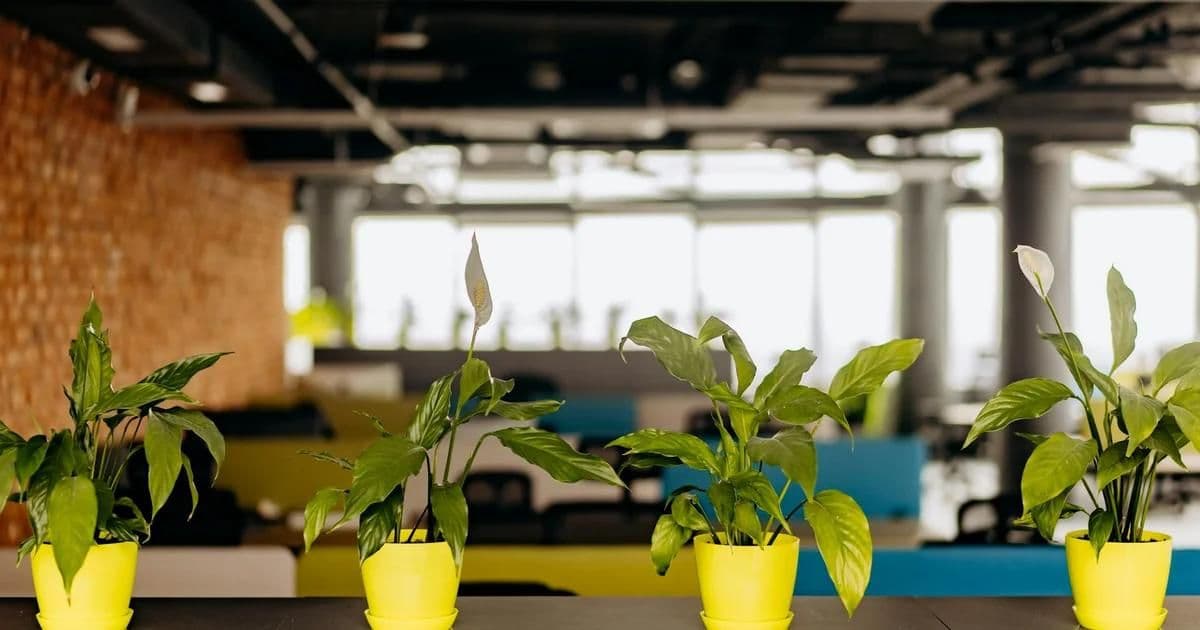
Biophilic Design in the Office: More Than Just Adding Plants
Someone puts a fern on their desk and calls it biophilic design. That is not how this works. True biophilic office design is a systematic approach to reconnecting people with natural systems — and the research behind it is striking enough to make any CFO pay attention.
What Biophilic Design Actually Means
Biophilic design is rooted in E.O. Wilson's 1984 biophilia hypothesis: humans have an innate need to connect with nature. We spent 99.9% of our evolutionary history in natural environments. Our nervous systems are still wired to respond to sunlight, flowing water, and organic shapes — not fluorescent tubes and grey cubicle walls.
In practice, biophilic design means deliberately incorporating nature and natural analogues into the built environment. It addresses:
- Direct nature experiences — real plants, water, natural light, airflow
- Indirect nature references — natural materials, organic geometry, biomimicry in patterns
- Spatial conditions found in nature — prospect and refuge, mystery, transition zones
A few potted succulents are a gesture. Biophilic design is a strategy that shapes the entire spatial experience.
The Business Case: Productivity Data and Wellbeing Studies
Let's talk numbers, because "it feels nice" doesn't get projects approved.
Productivity gains:
- A 2015 Human Spaces study (7,600 workers, 16 countries) found offices with natural elements reported 15% higher wellbeing and 6% higher productivity.
- University of Exeter research showed enriching a lean office with plants increased productivity by 15%.
- Terrapin Bright Green estimated biophilic interventions yield meaningful annual gains per employee in improved performance and reduced absenteeism. For more on how layout affects output, see our guide on office interior design and productivity.
Health and wellbeing:
- Natural daylight in offices is linked to 46 minutes more sleep per night (Journal of Clinical Sleep Medicine).
- Post-occupancy studies consistently show reduced cortisol levels in biophilically designed spaces.
- Workers with better nature views take fewer sick days and report higher job satisfaction (Heschong Mahone Group).
Talent retention:
- In competitive hiring markets, office environment directly influences where people choose to work. A 2020 Leesman Index analysis found that workplace design is among the top three factors employees consider when evaluating an employer.
The business case is documented, repeatable, and the ROI timeline is typically under two years.
Beyond Plants: The 14 Patterns of Biophilic Design
Terrapin Bright Green's 14 Patterns of Biophilic Design is the most widely used framework. Understanding it reveals how much territory biophilic design actually covers.
Nature in the Space (direct experiences):
- Visual Connection with Nature — views to living things, landscapes, or water
- Non-Visual Connection with Nature — sounds, scents, textures referencing nature
- Non-Rhythmic Sensory Stimuli — unpredictable natural movements (rustling leaves, rippling water)
- Thermal and Airflow Variability — subtle changes in temperature and air movement
- Presence of Water — seeing, hearing, or touching water
- Dynamic and Diffuse Light — variations in light intensity and shadow over time
- Connection with Natural Systems — awareness of seasonal and ecological processes
Natural Analogues (indirect references):
- Biomorphic Forms and Patterns — organic, non-linear shapes in furniture and architecture
- Material Connection with Nature — wood, stone, wool, leather reflecting local geology
- Complexity and Order — fractal patterns and hierarchical structures found in nature
Nature of the Space (spatial conditions):
- Prospect — unobstructed views over a distance
- Refuge — sheltered, enclosed spaces for withdrawal
- Mystery — partially obscured views that entice exploration
- Risk/Peril — a controlled sense of danger (glass floors, cantilevered balconies) that triggers alertness
Most offices only address patterns 1 and 9 — a plant and some wood panelling. The real opportunity lies in the other twelve.
Natural Light and Views
If you change only one thing about an office, make it this. Natural light is the single most impactful biophilic intervention, and it costs nothing to maintain.
Why it matters so much:
- Natural light regulates circadian rhythms, which govern sleep quality, alertness, and mood.
- Daylight shifts in colour temperature throughout the day — cool and energising in the morning, warm and calming in the afternoon. No artificial system replicates this as effectively.
- Views to the outdoors provide micro-restorative experiences. Even a brief glance at a tree canopy activates the parasympathetic nervous system.
Practical strategies:
- Maximise perimeter glazing. If the floor plate is deeper than 15 metres, consider lightwells or atrium cuts.
- Remove visual barriers near windows. Private offices along the window line are a legacy layout that starves the majority of daylight — a problem we explore further in open plan vs private offices.
- Use light shelves and reflective ceiling planes to bounce daylight deeper into the space.
- Specify glass with high visible light transmittance (VLT) — balance heat gain control with useful daylight.
- If true daylight isn't possible, tunable LED systems that mimic circadian colour shifts are a supplement, not a substitute.
In Istanbul, where commercial districts enjoy strong sunlight eight months a year, there is no excuse for dark office interiors.
Water Features and Natural Materials
Water engages multiple senses simultaneously — sight, sound, and even the feel of humidity in the air. It is one of the most powerful biophilic elements, and one of the most underused in office design.
Water in the workplace:
- A lobby water wall creates a sensory transition from the street to the interior — signalling arrival and decompression. The same principle drives spa interior design, where water features anchor the entire experience.
- Small recirculating features near breakout areas provide acoustic masking and visual calm without major infrastructure.
- Aquariums in communal areas lower blood pressure and reduce anxiety.
- Modern recirculating systems with UV sterilisation require very little upkeep.
Natural materials:
The goal is authentic materials that age gracefully — not plastic laminates printed to look like wood.
- Timber — exposed ceiling beams, solid wood desking, timber cladding. The scent of wood has measurable stress-reduction properties.
- Stone — reception counters, flooring, accent walls. Local stone connects the building to its geological context.
- Natural textiles — wool felt acoustic panels, linen upholstery, jute rugs.
- Living walls and moss panels — vertical gardens for spaces where floor area is limited. Preserved moss requires zero watering.
- Cork, bamboo, and rattan — versatile, sustainable materials, and increasingly available in specification-grade products.
One important principle: material honesty. A wood-printed vinyl floor does not trigger the same neurological response as actual timber. Our brains are good at detecting fakes — the warmth, the imperfections, the smell all matter.
Implementing Biophilic Design in Your Office
You don't need to demolish your office. Biophilic design can be implemented incrementally, and even modest interventions produce measurable results.
Start with an audit:
- Map your floor plan against the 14 patterns. Which are present? Which are absent?
- Survey employees about thermal comfort, daylight access, and noise. Baseline data makes post-intervention comparisons possible.
- Photograph the space at different times of day to reveal lighting opportunities.
Quick wins (low cost, high impact):
- Relocate desks closer to windows. Many offices waste premium perimeter zones on storage or meeting rooms.
- Replace one artificial material with a natural one. Swap a laminate meeting table for solid timber.
- Add a small water feature in a communal area.
- Introduce acoustic planting — large-leaf plants in strategic positions that absorb mid-frequency sound while adding visual nature.
Medium interventions:
- Install living walls or moss panels in high-traffic areas.
- Upgrade lighting to circadian-responsive systems.
- Create refuge spaces — partially enclosed nooks with lower ceilings and soft materials for focused work.
Comprehensive redesign:
- Reconfigure the floor plate to maximise daylight penetration.
- Integrate an atrium or indoor garden as the social heart of the office.
- Design transition zones using changes in light, material, and ceiling height.
- Commission a biophilic design consultant aligned with the 14 patterns framework.
Common mistakes to avoid:
- Treating plants as the entire strategy. They are one element of fourteen.
- Choosing high-maintenance species without a care plan. Dead plants are worse than no plants.
- Ignoring acoustics. Open offices with hard surfaces and no sound masking create stress. Water features, planting, and natural-fibre panels work together.
- Greenwashing. A single living wall behind reception does not make an office biophilic.
FAQ
Does biophilic design only work in new buildings? Not at all. Most interventions — better lighting, natural materials, planting, water features — can be retrofitted into existing offices. Start with the highest-impact changes and build from there.
How much does biophilic office design cost compared to conventional fitout? Simple interventions (relocating desks, adding planting) add modestly to a fitout budget. Comprehensive redesigns cost more. Productivity and retention gains typically deliver a return within 12-24 months.
Which plants work best in offices with limited natural light? Pothos, ZZ plants, snake plants, and peace lilies all tolerate low light well. For larger statement planting, Kentia palms and Dracaena are reliable. Always match species to actual lux levels in each zone — a reputable interior landscaping company will do a light survey before recommending species.
Can biophilic design help with noise in open-plan offices? Yes. Dense planting absorbs mid-frequency sound. Living walls and moss panels dampen broader frequencies. Water features mask distracting speech with ambient sound. Natural-fibre panels (wool felt, cork) perform comparably to synthetics while reinforcing the biophilic palette.
Is there a certification or standard for biophilic design? The WELL Building Standard includes a biophilia precondition. LEED awards credits for daylight, views, and indoor environmental quality. The Living Building Challenge has the most ambitious nature-integration requirements. No standalone "biophilic certification" exists, but these frameworks provide measurable benchmarks.
How do you maintain living walls and indoor water features? Living walls need automated drip irrigation, periodic plant replacement (5-10% per year), and occasional pruning — budget for ongoing annual maintenance. Water features need pump maintenance, water treatment, and quarterly servicing. Both are less demanding than clients expect.
Get in Touch
Let's Bring Your Project to Life
Planning a new project? Let's realize your vision together.